Several of our contributors have recently read Victoria Aveyard's Red Queen, a new and heavily hyped YA novel.
As a group, we were wary, as most of us have also read (and loved) Pierce Brown's Red Rising. The commonalities in the plot are hard to miss. Both feature a society with a color-based class system, with Reds at the bottom and Golds or Silvers at the top. Both feature a plucky young Red who, through no particular plan of their own, infiltrates the most elite circle of the upper class, and if their true nature is exposed they risk death. Both intend to upend the rigid social heirarchy by working from the inside.
Oh, and did i mention one's named Darrow, and one is named Mare Barrow?
Either putting our concerns aside, or holding them tight and making a bowl of popcorn first, we read Red Queen. And a funny thing happened: some of us liked it, and some of us didn't, but we all agree it wasn't very good.
When we disagree on a book, it's often the case that what the low-star camp cites as plot holes, inconsistencies, or just nonsense are details the high-star camp can explain, justify, or otherwise believe. For example, when we disagreed wildly about Winner's Curse, it was the exact same elements that made or broke the book for each group.
However, in this case, both the pro-Red Queen and anti-Red Queen camp agreed: this story is full of plot holes, character inconsistencies, flawed worldbuilding, and, frankly, nonsense. We got together and had a lovely time listing out all the things that Just Plain Didn't Make Sense. It's not a short list. This is not a plot that can withstand even casual scrutiny.
But while some readers refer to The List to justify why they didn't like the book, others acknowledged the list and insist the book is worth reading anyway.
One is reminded, in a way, of Summer Blockbuster Movies, which are often more about spectacle than content. While you can sit down and make a (very long) list of the problems with, say, Die Hard, most people will still agree that it's a fun movie worth watching. So why is it different with a book?
I was one of the readers who, despite my misgivings, ended up enjoying the book. I think the reason i liked it has to do with the fact that it is, in several ways, a Superhero Story. Mare is a bit like an X-Men mutant, and i spent a fair deal of my youth watching the X-Men animated series, collecting the cards, and blowing my allowance on the comic books. Any comic book fan has to have a habit of overlooking the kind of errors that plague Red Queen, otherwise they probably wouldn't enjoy comic books in the first place.
Reading is always going to be a subjective experience. One person's Favorite Book Ever is a stack of pages that another reader couldn't even finish. But it's rare to find a book like this, that everyone seems to agree is deeply flawed while disagreeing about its merit. I invite my fellow bloggers to add their own comments about why they liked or disliked this book.
Disclosure: most, if not all, of us who red Red Queen got the Advance Readers Copy for free through the Amazon Vine program.
We're a bunch of independent and independent-minded readers, eager to share our thoughts and opinions of upcoming and recently published fiction and non-fiction. Join the conversation!
Showing posts with label Dystopia. Show all posts
Thursday, February 12, 2015
Wednesday, December 3, 2014
Parallel Books in Parallel Universes - The Duplexity
I really hoped i'd like this book, as both the plot and the meta-plot
(two books, each tracing one side of the universe-swap) appeal to me.
I didn't just like it. I loved it. Even the minute bits like a girl-scientist, a platonic hetero-friendship, a boy-artist, all the stuff that never seems to make its way into YA fiction felt very natural here. And yes, there was an unlikely romance that developed quickly, but it wasn't just gazing into each other's eyes and knowing instantly that they were soul mates; they actually had to get to know each other first. And the icing on the cake: no forced love triangle! In fact, no love triangle at all!
The mystery of what the heck happened to Danny weaves into Eevee's own personal renaissance to make a story that just has a life of its own. Real world obligations prevented me from reading it all in one sitting, but i totally could have. And when the sequel comes out, i'll call in sick if i have to.
Because if there's one thing wrong with this story, it's that the whole time i wished i was reading Part 2. Dystopia Danny coming to a reality that seems a lot like ours was riveting, but i'm twice as excited to read about Slacker Danny landing in dystopia.
____________________
Now That You're Here (Duplexity Part 1)
Author: Amy Nichols
Publisher: Knopf Books for Young Readers (December 9, 2014)
Received free of charge from the Amazon Vine program
I didn't just like it. I loved it. Even the minute bits like a girl-scientist, a platonic hetero-friendship, a boy-artist, all the stuff that never seems to make its way into YA fiction felt very natural here. And yes, there was an unlikely romance that developed quickly, but it wasn't just gazing into each other's eyes and knowing instantly that they were soul mates; they actually had to get to know each other first. And the icing on the cake: no forced love triangle! In fact, no love triangle at all!
The mystery of what the heck happened to Danny weaves into Eevee's own personal renaissance to make a story that just has a life of its own. Real world obligations prevented me from reading it all in one sitting, but i totally could have. And when the sequel comes out, i'll call in sick if i have to.
Because if there's one thing wrong with this story, it's that the whole time i wished i was reading Part 2. Dystopia Danny coming to a reality that seems a lot like ours was riveting, but i'm twice as excited to read about Slacker Danny landing in dystopia.
____________________
Now That You're Here (Duplexity Part 1)
Author: Amy Nichols
Publisher: Knopf Books for Young Readers (December 9, 2014)
Received free of charge from the Amazon Vine program
Wednesday, November 26, 2014
Best Books of 2014
Just in time for the holiday season, here are some of our bloggers' picks for the best fiction and non-fiction books of 2014. Rest assured, we agonized over these choices. Please tell us why you agree or disagree in the comments. And if you think there's a book we overlooked, let us know!
__________
This book starts
with a gut-punch and never lets go. While relying on many of the tropes
now common in YA fiction (member of a suppressed class trying to bring
the system down, etc), it manages to be entirely unique.
Non-fiction: The Vinedresser's Notebook, by Judith Sutera
This book is simple, meditative, and contemplative, based primarily on grape vine metaphors to teach patience and humility. Though short, it's powerful. I don't believe it's possible to read this book and not become a better person in the process.
__________
Aaliya isn't the most likable fictional character: she shuns her neighbors, preferring books to reality. But then her reality is Beirut, through civil war, chaos and lots of family upheaval. Aaliya, however, is an astute, wry observer of those realities, and Alameddine is a lyrical writer: the combination has made the novel, one of the first I read this year, one of the most memorable and my favorite.

Non-fiction: A Spy Among Friends, by Ben Macintyre
Focusing on Kim Philby, one of the British spies whose betrayals rocked the British establishment in the 1950s and 1960s, this takes a different approach to the story, telling the tale through the eyes of Nicholas Elliottt, Philby's closest friend in MI6. For Elliott, Philby's betrayal was more than just treason: it was a personal violation of the most profound kind. The book is both a fast-paced spy yarn and a heartbreaking tale of betrayal and misery.
__________
Josh Bell thinks his school year is going to be all about basketball and how amazing he and his twin brother can be on the court, but life has something else in store. His words zing off the page showing how great poetry can be to illustrate life's good and bad moments.
Non-fiction: Birdmen: The Wright Brothers, Glenn Curtiss, and the Battle to Control the Skies, by Lawrence Goldstone
A title with a little bit of everything, Goldstone makes the history of heavier than air flight available to even the least scientific of minds. Thrills, chills, spills and daredevils from the golden age of early aviation all highlight the battle to get airplanes and their inventors off the ground.
__________
I judge the quality of a novel by how much I wish I could be reading it when I'm doing other things. In this case, those other things included visiting friends for the weekend and attending the National Book Festival, but I still found myself sneaking out this book to read a few pages whenever I could. The story of a missionary witnessing to aliens on another planet while his wife experiences apocalyptic conditions back on earth was unlike anything I've read before.
Non-Fiction: How We Learn, by Benedict Carey
This is probably the non-fiction book that's had the most real impact on my life this year. It's a fascinating synthesis of recent and not-so-recent findings in learning science, or in practical terms, a book full of evidence-based suggestions for how to learn more effectively and efficiently. Besides the helpful ideas themselves, I found it extremely encouraging just to read that forgetting is not the enemy of learning, that there are specific techniques that make it easier to remember foreign vocabulary within a reasonable time frame, and so on. This book gives me reason to hope that I'm nowhere near the limits of my abilities yet.
__________
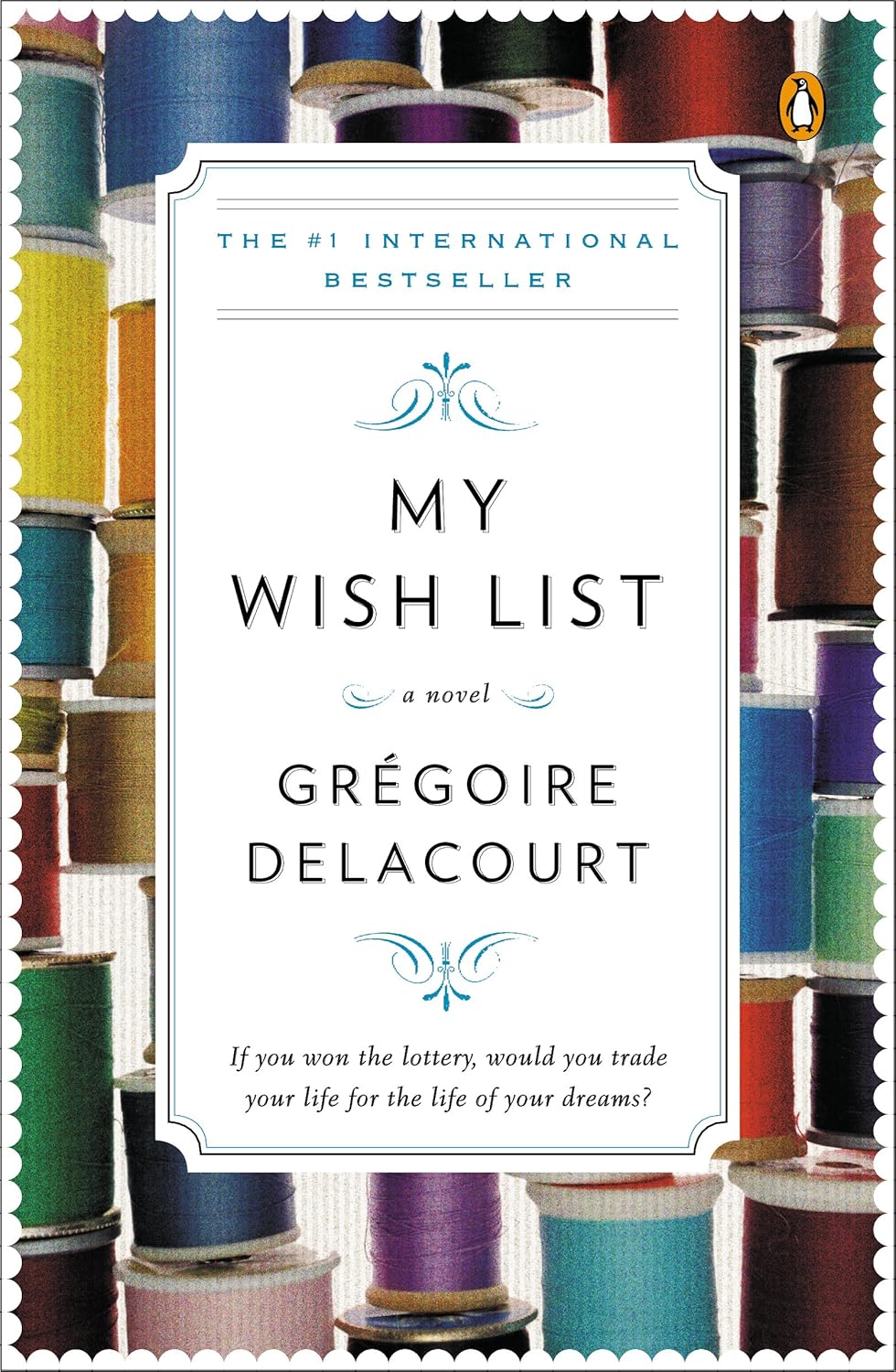
Fiction: My Wish List, by Gregoire Delacourt
This book asks an unoriginal question (What if you won the lottery?) and answers it in a completely original way. A compact story that felt simultaneously surprising and inevitable.
Non-Fiction: The Shelf: Adventures in Extreme Reading, by Phyllis Rose
A book in which reading a random shelf of library books becomes a discussion about book covers, undiscovered authors, blurbs, how libraries decide which books to discard, dog training, and occasionally, literature. The Shelf combined two of my favorite topics, books about books and harebrained schemes, brilliantly.
__________
Fiction: Red Rising, by Pierce Brown
If you mixed together a dash each of Lord of the
Flies, Hunger Games, Hogwarts Academy, and Roman history and set it
hundreds of years in the future you might come up with this book. But it
is fresh and exciting even with all those familiar elements. I could
barely put it down and can't wait for the next book in this trilogy due
in January 2015.
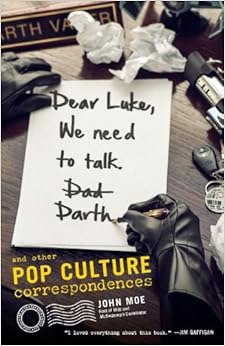
Nonfiction: Dear Luke, We Need to Talk, Darth: And Other Pop Culture Correspondences, by John Moe
I read mostly for entertainment so don't do much nonfiction. This collection of John Moe's imagined letters, e-mails, text messages, and other correspondence behind some favorite pop culture references made me laugh.
__________
Fiction: The Secret of Magic, by Deborah Johnson
Deborah Johnson stole my heart back in January with The Secret of Magic, a masterful interweaving of tradition, resilience, injustice, idealism, and respect. In impeccably measured prose that is all the more beautiful for being unassuming, Johnson introduces us to an idealistic young lawyer, a gentle and righteous father, and the author whose words have impacted both their lives. Even as she evokes the tensions of the post-WWII South, she also layers in such talismans as ladybugs, mistletoe, and a mailbox full of bluebirds. These and many other moments sing of simplicity while they hint at deeper meaning.
Non-fiction: The Nazis Next Door, by Eric Lichtblau
Coincidentally, my other selection also centers on events in the U.S. just after WWII. Eric Lichtblau's The Nazis Next Door: How America Became a Safe Haven for Hitler's Men is a thorough, professional, and incredibly frustrating exploration of the warm welcome the U.S. government extended to a number of people involved in the German war effort. This book is an implicit indictment of the choices some members of our government made that ran counter to the tenets on which we like to think the social contract of our country exists. When you tackle this worthwhile book, give yourself permission to partake of it in 50- to 60-page increments.
__________
Note: Most, if not all, of these were received as ARCs through the Amazon Vine program.
__________
Silea's picks:
Fiction: Red Rising, by Pierce Brown
This book starts
with a gut-punch and never lets go. While relying on many of the tropes
now common in YA fiction (member of a suppressed class trying to bring
the system down, etc), it manages to be entirely unique. Non-fiction: The Vinedresser's Notebook, by Judith Sutera
This book is simple, meditative, and contemplative, based primarily on grape vine metaphors to teach patience and humility. Though short, it's powerful. I don't believe it's possible to read this book and not become a better person in the process.
__________
Suzanne's Picks
Fiction: An Unnecessary Woman, by Rabih Alameddine:Aaliya isn't the most likable fictional character: she shuns her neighbors, preferring books to reality. But then her reality is Beirut, through civil war, chaos and lots of family upheaval. Aaliya, however, is an astute, wry observer of those realities, and Alameddine is a lyrical writer: the combination has made the novel, one of the first I read this year, one of the most memorable and my favorite.

Non-fiction: A Spy Among Friends, by Ben Macintyre
Focusing on Kim Philby, one of the British spies whose betrayals rocked the British establishment in the 1950s and 1960s, this takes a different approach to the story, telling the tale through the eyes of Nicholas Elliottt, Philby's closest friend in MI6. For Elliott, Philby's betrayal was more than just treason: it was a personal violation of the most profound kind. The book is both a fast-paced spy yarn and a heartbreaking tale of betrayal and misery.
__________
JWP's Picks
Fiction: Crossover, by Kwame AlexanderJosh Bell thinks his school year is going to be all about basketball and how amazing he and his twin brother can be on the court, but life has something else in store. His words zing off the page showing how great poetry can be to illustrate life's good and bad moments.
Non-fiction: Birdmen: The Wright Brothers, Glenn Curtiss, and the Battle to Control the Skies, by Lawrence Goldstone A title with a little bit of everything, Goldstone makes the history of heavier than air flight available to even the least scientific of minds. Thrills, chills, spills and daredevils from the golden age of early aviation all highlight the battle to get airplanes and their inventors off the ground.
__________
Dunyazad's Picks
Fiction: The Book of Strange New Things, by Michel FaberI judge the quality of a novel by how much I wish I could be reading it when I'm doing other things. In this case, those other things included visiting friends for the weekend and attending the National Book Festival, but I still found myself sneaking out this book to read a few pages whenever I could. The story of a missionary witnessing to aliens on another planet while his wife experiences apocalyptic conditions back on earth was unlike anything I've read before.
Non-Fiction: How We Learn, by Benedict Carey
This is probably the non-fiction book that's had the most real impact on my life this year. It's a fascinating synthesis of recent and not-so-recent findings in learning science, or in practical terms, a book full of evidence-based suggestions for how to learn more effectively and efficiently. Besides the helpful ideas themselves, I found it extremely encouraging just to read that forgetting is not the enemy of learning, that there are specific techniques that make it easier to remember foreign vocabulary within a reasonable time frame, and so on. This book gives me reason to hope that I'm nowhere near the limits of my abilities yet.__________
TakingaDayOff's Picks
This book asks an unoriginal question (What if you won the lottery?) and answers it in a completely original way. A compact story that felt simultaneously surprising and inevitable.
Non-Fiction: The Shelf: Adventures in Extreme Reading, by Phyllis RoseA book in which reading a random shelf of library books becomes a discussion about book covers, undiscovered authors, blurbs, how libraries decide which books to discard, dog training, and occasionally, literature. The Shelf combined two of my favorite topics, books about books and harebrained schemes, brilliantly.
__________
Sandy Kay's picks
Nonfiction: Dear Luke, We Need to Talk, Darth: And Other Pop Culture Correspondences, by John Moe
I read mostly for entertainment so don't do much nonfiction. This collection of John Moe's imagined letters, e-mails, text messages, and other correspondence behind some favorite pop culture references made me laugh.
__________
CK's picks
Fiction: The Secret of Magic, by Deborah JohnsonDeborah Johnson stole my heart back in January with The Secret of Magic, a masterful interweaving of tradition, resilience, injustice, idealism, and respect. In impeccably measured prose that is all the more beautiful for being unassuming, Johnson introduces us to an idealistic young lawyer, a gentle and righteous father, and the author whose words have impacted both their lives. Even as she evokes the tensions of the post-WWII South, she also layers in such talismans as ladybugs, mistletoe, and a mailbox full of bluebirds. These and many other moments sing of simplicity while they hint at deeper meaning.
Non-fiction: The Nazis Next Door, by Eric Lichtblau
Coincidentally, my other selection also centers on events in the U.S. just after WWII. Eric Lichtblau's The Nazis Next Door: How America Became a Safe Haven for Hitler's Men is a thorough, professional, and incredibly frustrating exploration of the warm welcome the U.S. government extended to a number of people involved in the German war effort. This book is an implicit indictment of the choices some members of our government made that ran counter to the tenets on which we like to think the social contract of our country exists. When you tackle this worthwhile book, give yourself permission to partake of it in 50- to 60-page increments. __________
Note: Most, if not all, of these were received as ARCs through the Amazon Vine program.
Thursday, October 23, 2014
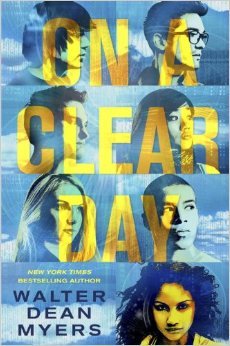
On A Clear Day - or The Call To Action That Wasn't
I received this book as part of the Amazon Vine Program.
On a Clear Day is one of those books that I wanted to love so much more than I did.
In the year 2035 the world is controlled by corporations. A group of teens decide to basically start a revolution, to topple the corporations, and just maybe change the world. Sounds like a great concept, doesn't it?
Unfortunately, for me, it just didn't work. The book begins well. We are introduced to a group of kids who are inherently cool. They each have their skills and their quirks and you believe that they just might do what they set out to. I liked the characters and enjoyed the unorthodox way the author introduces them.
However, the book suffered for me on two fronts.
First, the world building. Frankly, the world building here is thin. I got that this was near future, but I never really bought into it. It felt like today with a few 'let's make this seem futuristic' trappings. I think I needed more history - more backstory - to explain why the world was the way it was. The entire time I was reading, I was never in the authors world in 2035. Maybe 2035 was too near and a bit harder to build out? I'm not sure, but it just didn't work.
The second place it failed was in the philosophizing. I love that the author is asking teens to think about the world and where it could end up. I love that he wants them to think about how they can change the world and what their values are.
But…it's still a book and it's still supposed to be entertainment. There's a lot of talking in the book. Speeches and discussions which seem more like an opportunity to get the author's view across than to move the story. I would rather the author had simply written an essay explaining his views, and let the story move.
So will teens read it and get something out of it? Some will - the more introspective and already politically minded ones might enjoy this and run with it. But as a call to action to ordinary teens, it fails in the execution, and I fear many will stop reading merely a quarter of the way through.
I liked where the author was going, but unfortunately, I don't think he ever got there.
Tabula Rasa
The story is told in the first person, and I don't think it could be told any other way. For the most part it is told in the present tense, which I generally don't care for, but it is needed, otherwise, the long memory sections would have awkward transitions through the past perfect. By casting the main story in present tense and the flashbacks in past, the narrative is able to maintain a cleaner flow.
This book is definitely not going to stand up to nit-picking, or careful scrutiny. Mainframes are mentioned quite often. If you think those are the giant, room-sized monsters we used to run Cobol on, they're not. Not in this book. They are either tablets, or maybe some kind of server class desktops. I'm not entirely certain. They are definitely supreme hacking machines.
"I killed the hospital's mainframe. But this awesome little thing"--he shakes the tablet--"connects to these soldiers' portable mainframes. This is the sort of the highest of the high-end stuff. Their portable mainframecan override every system in the place."
"How?"
"This thing blots out one signal and replaces it with a stronger one. It can even override hardwired connections."
The neurology is even worse. Just accept that the pseudo-science stuff is just code for "they cast a high-tech, highly focused forget spell on her" and you'll be fine.
Where this book excels, and really, where any good book should excel, is characterization.
It hits three major themes: dystopia, coming of age, and falling in love. It's hard to fail with any of those, and all three are handled very well.
We start with a hospital, and outside of flashback, we generally stay on the hospital grounds, trapped by a raging storm that isolates an already isolated facility. Teenagers and young adults are being wiped clean of their memories, and to some extent their personalities, as they are given a fresh start, a blank slate. From the beginning we get the sense that something is wrong, and that subtle wrongness is allowed to build just enough before the action starts. As we get the details, bit by bit throughout the story, we come to understand the darkness, and surprisingly the love father to child, to drives the place. It is not mindless evil to be evil, the trap of some dystopias. It is the perversion of good intentions, the subtle corruption that destroys the system, that is the mark of an excellent dystopia. All of the questions are not answered, and I'm not sure they needed to be. This book, despite its closed environment, is grand in scope and leaves the reader with a sense of a huge world where answers just lead to more questions. I definitely want to see more from Kristen Lippert-Martin in this vein.
Sarah and Pierce both grow, and both transform even their names as they come into themselves. We get hints throughout that Sarah is special. She can catch jelly beans in her mouth no matter where they are thrown. She has an almost obsessive ability to track her environment. Pierce, conversely, goes from the one with all the answers, seeming to almost jealously guard them, to someone more willing to open up to others. She learns to fly. He learns to trust.
The romance is a subtle undercurrent that flavors, but at no point threatens to overpower, the narrative. It was handled with a deft hand, that makes it less of a Stockholm syndrome romance than most.
The body count, and to some extent the lack of reaction by the main characters to the body count, is however a bit disturbing.
Overall, I found it engaging dystopia. Not a perfect novel, but one good enough to be worthy of a read. Especially recommended for overstressed readers who just need a good escape novel.
I received this book free from NetGalley in exchange for an honest review.
Subscribe to:
Posts (Atom)