Tuesday, August 4, 2015

"Milo Speck, Accidental Agent" is a delightful Dahl-esqe fantasy adventure for younger middle grade readers

I am much much older than the target audience for this book, but it grabbed me from the opening paragraph.  I am quoting  from the ARC, so something might have changed in the final published version of the book, but it gives you a good sense of the flavor of this book:

Milo had read about magic before.  He knew that kids in stories sometimes found magic in secret drawers or hidden away in attics, and he had always hoped that if he were to find magic, it would appear in the form of a mysterious silver coin or a doorway to an enchanted world.  But when magic came to Milo Speck, it came in the form of a sock.  

A sock?!?  Something about that passage captured my attention and pulled me into a story about a very small boy sucked into a world of hilariously doltish (but very large and dangerous) ogres who enjoy snacking on boys.  The story had a very familiar feeling of tongue-in-cheek absurd humor combined with heart but it wasn't until reading the author's note at the end that I realized why -- one of the writers she credits for inspiration is Roald Dahl.  It would be a disservice to compare any writer to the great Roald Dahl, but younger readers who like the kind of humor found in books like "The BFG" should really enjoy this book as well.

Milo Speck, is an unlikely hero.  He is small for his age and his "Grandmother" dresses him in ridiculous clothes that she buys on clearance.  As this book opens, he is wearing a googly-eyed duck sweatshirt that "quanks."  Through an unlikely act of magic,* Milo is transported to Ogregon where he has to avoid becoming an ogre snack, rescue some other kids, figure out what his Dad is doing there, and find a way back home.   There is a lot more to the story, but I don't want to spoil the fun by giving away anything more than what is in the publisher's book blurb.

I really enjoyed the combination of silly fun and adventure in this book and would recommend it for readers on the younger end of the 9-12 age range.  It would also be appropriate for children younger than 9 whose reading level is beyond their years.  Older children might like it as well, especially if they aren't yet ready for the more mature Young Adult books.

It's a great book to recommend for boys who will enjoy going on this adventure with Milo as he  uses his wits and heart to survive the ogres.  Girls will enjoy it as well, but I always like to find books that I think will appeal to boys to encourage them to read more.

*For parents who are uneasy with the idea of magic in books, I hope you will not avoid this book on those grounds.  Milo is not a wizard and has no magic abilities.  He's just a regular boy. The "magic" in the book is mostly confined to the ability to travel between the regular world and Ogregon, though there is brief discussion of some other "magical" creatures in other parallel lands.  The characters themselves don't do magic.

I received an Advanced Readers Copy free through Amazon's Vine program in exchange for a review.

Saturday, April 11, 2015

The Sandwich Test

I'm not sure how i came up with the Sandwich Test. I suspect the idea started with one of Yahtzee Croshaw's critical video game reviews, wherein he often compares disappointing characters to various inanimate objects. However, the Sandwich Test is now my primary metric for judging novels. It goes like this:

Would the story be meaningfully different if you replaced the main character with a sandwich?

In too many of the YA novels i've been reading lately, main characters might as well be sandwiches. They don't do anything, they just are. People do things for them, or about them, or around them. People move them from one location to another. These characters, and every one that leaps to mind is, alas, female, might as well be a sandwich for all it matters to the story.

And why a sandwich, you ask? Why not a pebble or a manequin or a sock? Well, two reasons. First, it's funnier, and keeps me sane when, for some reason, i decide to stick it out in a book that already failed the test. Second, there are actually a variety of sandwiches out there, and that allows other characters to interact with the sandwich in ways they wouldn't necessarily interact with a pebble. Cribbing from one of my own reviews, in which i compare a character to a pastrami sandwich:

But of course, people have strong feelings about her. Some are repulsed (perhaps they're vegetarians?), some want her but know to stay clear (on a diet, maybe?), whereas others want to possess her (pastrami connoisseurs, in this example).

It's been a while since i read the Hunger Games trilogy, so i can only use it for general examples, but here goes:

In book 1, Katniss is a person. She's struggling to keep her family alive, hunting and trading and dodging the cops. When Prim is selected, Katniss leaps forward to volunteer herself in her sister's place. In the games, she makes alliances, she attacks and defends, she even stands up to the Powers That Be at the conclusion of the games.

By book 3, she's a Sandwich, being handed around by various factions. She does what people tell her, and if no one has anything for her to do, she sits there. By the end, she's not even a good sandwich, she's a day-old soggy cold cut sandwich.

So, readers, next time you're frustrated with a character who doesn't DO anything, use your spare time deciding exactly what kind of sandwich they are. BLT? Club? Hummus wrap?

And authors, please, don't write any more sandwiches.

Tuesday, March 24, 2015

Let he who has done his own fact-checking cast the first stone

So You've Been Publicly Shamed, by Jon Ronson
Published by Riverhead Hardcover (March 31, 2015)

 I think Ronson's arguments about the actual psychological and social damage of shame are powerful and important. However, several times during reading, i laughed. Out loud. And not at anything that was supposed to be funny.

For example, in a book about shaming, the author attributes the efficacy of those signs on the side of the road that tell you your speed to... feedback loops. He thinks the value is in showing you your speed, not in showing everyone around you. It's a shaming device, at least in part. And that's ignored.

Another one: after chapters and chapters and chapters of Jonah Lehrer observing that if he'd only fact-checked his book, he'd have saved himself a lot of trouble, Ronson gets Godwin's Law wrong. He cites a corollary of it as if it were the law itself. 15 seconds on wikipedia would have been enough to get that one right.

So... valuable insight, oddly shoddy writing and editing. Certainly very readable, and probably worthwhile, but it only escaped being thrown at the wall because i was reading it in a public place with innocent bystanders nearby.

(I received a free Advance Reader's Copy of this book through Amazon Vine.)

Tuesday, February 24, 2015

On The Beach for a New Generation


Author:  Tommy Wallach
Publisher: Simon & Schuster Books for Young Readers (3/24/15)


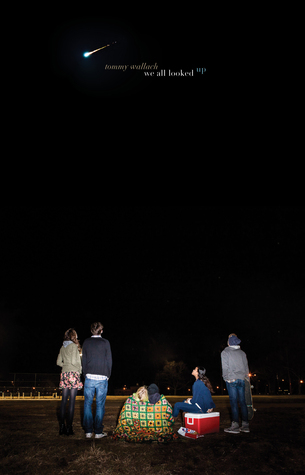
The plot of We All Looked Up may seem familiar.  An asteroid is headed towards Earth.  While it's possible that it won't hit, the probability is that it will hit and the world will end in about two month's time. 

Now, I loved this book, but for some reason, publishers keep comparing this to The Stand.  Wipe any thought of The Stand out of your mind. That's an awful comparison because it's got nothing in common with it. The one book that did keep running through my head was On the Beach by Nevil Shute . It's not a story about the apocalypse so much as it is about the philosophy of life. What would you do if you knew with almost absolute certainty that you would die within two months?

The teens in this book are vibrantly, brilliantly alive. They love and hate. They smoke out, they play music, they have sex, they adore each other and betray each other, and they do every day ordinary teen things. They are young and feel immortal. They've got their entire lives ahead of them.

Until they don't.

While the story focuses on one school and one group of kids, the story feels more global than that. You get to witness both the good and the bad of the way society deals with impending destruction.

At its heart, though, the book is about dreams, about learning what's most important, and about living life to the fullest. It manages to be both hopeful and heartbreaking all at once.

The writing is beautiful, the characters more authentic than you would expect, and the story keeps your attention to the last page.

Have you seen it before? Sure, but it's a new generation and it works.


*ARC Provided via Amazon Vine Program

Monday, February 23, 2015

And the 2015 Newbery Award Goes To...

Introduction
Awards are popularity contests.  The Newbery Medal, given to the author whose book is considered to be the most distinguished in children’s literature out of a year’s worth of books aimed at young readers, is no different.  I have never been on an awards committee.  I have spoken to and taken classes from library professionals who have been on awards committees including the Newbery.  They all are in some level of agreement that the most passionate voice often holds sway.  This is not to say that book awards are without merit and that what goes on behind closed doors is not important.

If you look at the winners of the most prestigious award in American literature for young readers from the inception of award the Newbery Medal in 1922, it’s rather obvious that the books selected have not been chosen by children for children.  The list of winners is plagued by works that have gone out of print (or should have if not for the award designation), been loved by adults but not children, and are often difficult to sell to the target audience.

To say a revolution is afoot might be a false claim, but there does seem to be a sense of change coming, slow as it is.  In 2008 the committees were chastised for selecting books that are not universally loved by young readers or even read by them or the people who regularly work with children.  However, the 2009 selection of Neil Gaiman’s The Graveyard Book not only connected with adults but, surprisingly is enjoyed by the target audience and a rare genre (science fiction, fantasy, mystery, and so on) selection.   (Nonfiction as winner is just as rare in case we're counting.)

Realistic fiction is awards bait between the dead or absent parents, children having to face the harsh realities of life such as the death of a loved one including but not limited to pets and family members, being misfits, being on a book long guilt trip, and just suffering in general.  Orphans and dead pets in particular have long been overused to create drama and force a coming of age moment in realistic children’s fiction.  So, for a book that has some of the previously listed elements but was also about friendship and family in a nontraditional way and a happened paranormal variety fantasy to be given the highest distinction, it was a sign that the times might be a changing.  Or Neil Gaiman's just that brilliant and most librarians love him and he just plain deserved the award that year.

Not all the winners and honors since then have broken the mold.  There is still plenty of favoritism in play and authors who, as well written and accomplished as they are, seem to simply awarded for publishing something in a given year.  All it takes is one voice, one person with a deep seated passion for one book to push a book to medal winning status.  It should be noted that any number of honor books can be designated from none to infinity, though in a given year there has never been more than four, though there are some years where none have been selected.

Below are the 2015 selections for the Newbery Medal and honors including a brief description of each and what might be some of the reasons why they were selected.

Winner
Alexander, Kwame.  The Crossover.  Boston: HMH Books for Young Readers, 2014.

Someone suggested to me that this novel in verse was not a story but unconnected poetry about basketball.  That person obviously did not read this book correctly.  Alexander's medal deserving book is, actual, a strong narrative. Twelve year old Josh Bell discusses the highs and lows of his last basketball season through a variety of poems.  What the book does well is make you feel the game even if you are not familiar with it.  Josh also has to tackle some big changes including the different path he is taking from his twin brother Jordan who is more interested in girls than sports.

Alexander gets to the heart of what it's like to grow up without needing a plethora of words or resorting to cheap tricks.  There's an honesty to the book and Josh as a character that is relatable regardless of one's age or background.  That the poetry feels natural and each one leads nicely into the next without a break in flow makes The Crossover stand out even more.  It so easily could have been a device, but Alexander's ability to foreshadow deftly means you're eased into even the most emotional moments without feeling you've been cheated.  Truly a masterful work and an example of how to craft a poetic novel that kids will enjoy. 

Honor Books
Bell, Cece.  El Deafo.  New York: Amulet Books, 2014.

The most interesting aspect of this book's selection for a Newbery honor is that it is, in fact, a graphic novel.  The Newbery awards writing.  The Caldecott is awarded to illustrators for book illustrations.  I don't think Bell's book would be exactly high up the list for the illustration award, but I can say that the writing is quite strong.  El Deafo is the author's mostly autobiographical account of growing up with hearing loss.  As a result of a meningitis infection at the age of four, she lost most of her ability to hear.  The story is as much about fitting in as it is about the author finding her own self worth and not letting others opinions rule her life.  Bell's writing of her own story appears to be of a no nonsense simplicity, but it still hits home as a coming into one's self story, made up alter egos and all.  Young readers will love the format and relate to the story, hijinks and all. Adults will appreciate the bunny ears used throughout even characters without hearing loss.

Woodson, Jacqueline.  Brown Girl Dreaming.  New York: Nancy Paulsen Books, 2014.

Woodson discusses what it was like to grow up essentially in two worlds and of finding her calling to writing through free verse poems.  She writes about complex topics such as having to grow up and navigate the different ways of life in the south and in New York City.  Family, religion, politics, and location are all recurring topics.  Woodson is an excellent writer of free verse contemporary novels, but the inclusion of this book also feels a bit like an oft honored author getting another nod for doing something a little different.  It's a different sort of autobiographical effort and the message of following one's dreams and believing in something including oneself are important parts of the narrative and worth consideration even if adults undoubtedly will get more from this book than children. 


Conclusion
The 2015 Newbery selections have the feel of a diversity that has not always been present in the awarding in the past, but still have a sense of similarity between them.  Two books are written in verse, one is a graphic novel, two are by women, two by writers of color, one by are biographical in nature, one by a person with hearing loss.  None are traditional narratives.  This may be progress, but at the same time an oft honored but never winner is among the group.  One thing is clear, though.  The award and awarding of the Newbery Medal and its honors has changed since 1922.  The times truly are a changing and it is only right that the writer to whom the Newbery Medal is awarded reflects the times.  I, at least, can say that the winner, Kwame Alexander, is getting well deserved recognition for crafting a book I not only enjoyed experiencing but enjoy giving to young readers who feel the same after reading it.
Monday, February 16, 2015

And Now for Something Completely Different: Why YA Love Triangles Need to Go

The love triangle.  We've all read one or hundreds in our lives.  One character gets involved with another and then a third person shows up who is more interesting or cares more or is just more and the world will end if our main character does not anguish over who to choose.  Below are two examples of books I recently read that include the love triangle cliche.

Example 1
Book one is styled as a fantasy, derivative fairy tale meets bizarre but true history and a romantic subplot.  The main character, aka first person narrator, is a seventeen-year-old and unsurprisingly naive girl who is betrothed to the prince.  Their relationship can be called distanced but amicable despite not having seen each other or really spoken to each other in the two years since their betrothal.  No sparks fly between them but there is nothing to say they couldn't make it work.

In comes the foreigner to unravel everything and be love interest number two.  The narrator has led a sheltered life and knows little of the world, so, of course, our worldly introduction will be interesting to her.  However, she almost instantly goes along with what he says and bam!  She's 'in love' to quote her from several times in the book.  Here is someone who has had zero references in her life to what true love and being in love is like, but she knows she's in love with someone who is still basically a stranger.  Their chemistry on page is worse than the chilly relationship between the narrator and her betrothed.  Dramatics ensue in which her loyalties to both are tested for various reasons including 'doing the right thing' and 'saving the kingdom.'

Example 2
In book two, this time a 'realistic' fiction, the narrator main character (again, seventeen-ish and female) is torn between jock perfection who she knows gets around but doesn't really know other than he's the hottest thing in school and that guy blindly devoted to her since childhood who her friends think is weird and kind of a loser.  One insists he can help solve her problems and the other basically just wants to hookup or something.


Both of the example books are being released by big publishing houses this year.  One senses the continuing of a trend.  The trend being the love triangle that drives teen angst.  Here's why it needs a break or to just disappear for a while:

Totes cliche
Everyone is doing it!  All you need to think about are some of the most popular YA series.  It's difficult to find one that doesn't triangle at some point and a number of none genre one offs pull the same tricks to apparently make the story more interesting.  There are authors (John Green whom I don't heart but respect for not triangling his romances) of works for teens capable of crafting realistic teen works without resorting to: 

Forced melodrama
Consider the usual love triangle plot.  Now take out one of those characters (preferably the least believable or most unsuited to the main character).  Yes, it changes the story - sometimes a lot - but it also shows that there might be a more interesting plot that comes to the fore.  Example 1 is a case where the melodrama of the romantic triangle distracted from what was interesting about the book.  I almost missed the good bits at the end because I had to wade through unnecessary relationships.  The main reason for the drama factor?  This:

The relationships themselves are implausible
When I think of most real-life teenage relationships including my own, they don't usually involve someone being forced to constantly pledge allegiance to one person or another romantically over the course of a predetermined amount of time.  I don't think my experience in this is singular, either, which might explain why the love triangle is most present in implausible or genre (fantasy, science fiction) scenarios.  The audience is already tuned to world being different, so why not make expectations of relationships that way? 
This is really a fault of the forced 'do I love him or do I love him' aspect of these type of books.  The romantic interest characters in question (usually hims) are often diametrically opposed.  One's the good guy, the other bad, so you get a whole other cliche can of fish.  The main character (usually hers) is always put in a situation where she doesn't wish to choose one or the other but one of them handles the problem better and thus must be the victor.  Except:

Nobody really wins
The love triangle is a game of cat and mouse where they're all chasing each other for the prized cheese, no exceptions.  It's an angstfest to 'create interest' or 'flesh out the characters' or, as is most often the case, 'show the main character who she really is.'  There are enough coming of age tales available that don't need romantic interests to be relatable to the target audience much less the people who read them for fun outside the target. 
In the end, the main character has always been through the emotional wringer, the love interests usually have gotten into a brawl with each other (sometimes fatally so), and none of them are truly happy despite the pretext that it can end happily ever after even in realistic fiction.  Katniss is a good example of being torn between loyalties and ending up content but not truly happy as well as being a victim of forced triangulation to intensify drama. 


Now, I'm not saying I expect the publishers and authors to completely do away with the triangle or even the rare love square.  They can be done well, but the problem lies in everything I just said above and some ideas I didn't even touch on.  Ideally the romantic interest, one singular interest, would have qualities of both the usual bad and good boys that bring out the best in the main character.  I scoff at the idea that a plausible relationship between two attracted characters can't be interesting without introducing a third (John Green, again, does this well even though I still don't particularly care for his books.)  Yes, the triangles sell and create marketing opportunities.  Yes, it is easier to say you're team whatevs versus team whatnots.  But just because those things are good for selling doesn't mean they're good to read all the time.  So, for a change now and then, let's try something completely different and not force love triangles into all our book.  I suspect the results will be much more interesting and certainly something different.

Thursday, February 12, 2015

Does a book have to be good to be enjoyable? Red Queen as a case study.

Several of our contributors have recently read Victoria Aveyard's Red Queen, a new and heavily hyped YA novel.

As a group, we were wary, as most of us have also read (and loved) Pierce Brown's Red Rising. The commonalities in the plot are hard to miss. Both feature a society with a color-based class system, with Reds at the bottom and Golds or Silvers at the top. Both feature a plucky young Red who, through no particular plan of their own, infiltrates the most elite circle of the upper class, and if their true nature is exposed they risk death. Both intend to upend the rigid social heirarchy by working from the inside.

Oh, and did i mention one's named Darrow, and one is named Mare Barrow?

Either putting our concerns aside, or holding them tight and making a bowl of popcorn first, we read Red Queen. And a funny thing happened: some of us liked it, and some of us didn't, but we all agree it wasn't very good.

When we disagree on a book, it's often the case that what the low-star camp cites as plot holes, inconsistencies, or just nonsense are details the high-star camp can explain, justify, or otherwise believe. For example, when we disagreed wildly about Winner's Curse, it was the exact same elements that made or broke the book for each group.

However, in this case, both the pro-Red Queen and anti-Red Queen camp agreed: this story is full of plot holes, character inconsistencies, flawed worldbuilding, and, frankly, nonsense. We got together and had a lovely time listing out all the things that Just Plain Didn't Make Sense. It's not a short list. This is not a plot that can withstand even casual scrutiny.

But while some readers refer to The List to justify why they didn't like the book, others acknowledged the list and insist the book is worth reading anyway.

One is reminded, in a way, of Summer Blockbuster Movies, which are often more about spectacle than content. While you can sit down and make a (very long) list of the problems with, say, Die Hard, most people will still agree that it's a fun movie worth watching. So why is it different with a book?

I was one of the readers who, despite my misgivings, ended up enjoying the book. I think the reason i liked it has to do with the fact that it is, in several ways, a Superhero Story. Mare is a bit like an X-Men mutant, and i spent a fair deal of my youth watching the X-Men animated series, collecting the cards, and blowing my allowance on the comic books. Any comic book fan has to have a habit of overlooking the kind of errors that plague Red Queen, otherwise they probably wouldn't enjoy comic books in the first place.

Reading is always going to be a subjective experience. One person's Favorite Book Ever is a stack of pages that another reader couldn't even finish. But it's rare to find a book like this, that everyone seems to agree is deeply flawed while disagreeing about its merit. I invite my fellow bloggers to add their own comments about why they liked or disliked this book.

Disclosure: most, if not all, of us who red Red Queen got the Advance Readers Copy for free through the Amazon Vine program.